Historical Background
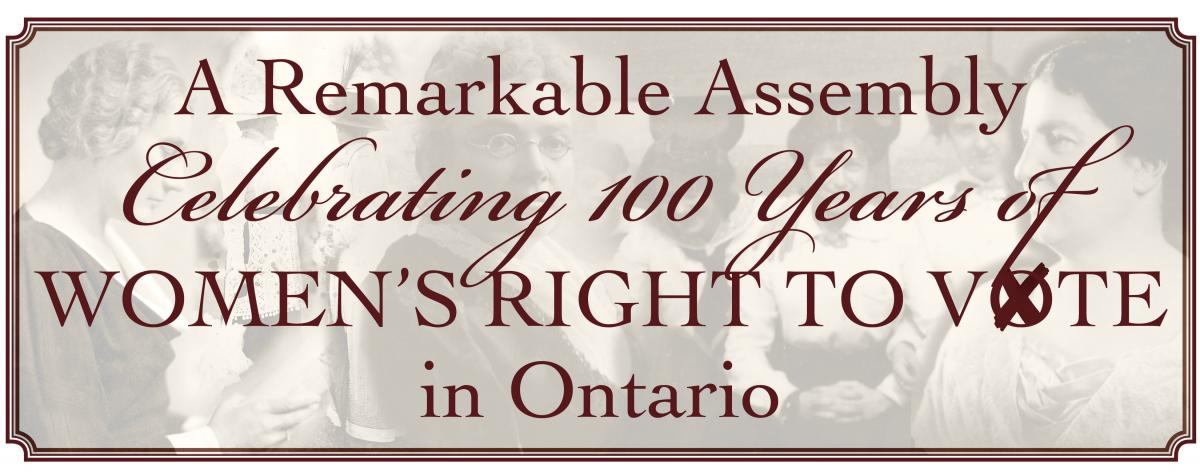
On April 12th, 2017, Ontario will mark the 100th anniversary of women’s right to vote in Ontario. After more than fifty years of activism by suffragists, Ontario became the fifth province to grant women the right to vote in provincial elections on April 12th, 1917. Immediately following Confederation, Ontario’s suffrage movement emerged from women who sought political representation as a means to improve women’s rights and assert influence in social, economic and political reform. Dr. Emily Stowe, the first female doctor to practice in Canada, and her daughter Dr. Augusta Stowe-Gullen led the early suffrage movement in the province.
Amid opposition from both men and women, Ontario’s suffragists raised awareness and support for their cause through the formation of organizations, participation in national and international meetings, petitions and lobbying at the municipal and provincial levels, and political theatre and writing. Suffrage victories in western Canada led the Ontario parliament to follow suit, granting women the right to vote in 1917. Not all female Ontarians received the provincial franchise in 1917. As with men, only those who were 21 or older, who were born or naturalized British subjects, and who had lived in the country for 12 months could vote. Those initially excluded from the provincial franchise included members of several ethnic and minority groups, Indigenous women living on reserves and female prison inmates. These groups received the right to vote throughout the latter half of the twentieth century, with female inmates being the latest to obtain the franchise in 2002.